Review of Unstoppable Gospel by Gregg Matte

In the Unstoppable Gospel, Gregg Matte joins a unique insightfulness into the book of Acts with a modern application.  By looking carefully at the life of the early church and applying descriptive principles of the early church for the church of our modern era, the reader is both challenged and encouraged about the power of the Gospel of Jesus.  Matte’s conviction of this point is expressed in the title.  The Gospel is unstoppable.  
Matte works through the first half of the book of Acts in this book.  He emphasizes the key qualities of the first Christians that led to the propulsion of the Gospel during the church’s early years.  Matte has a skill for unpacking these qualities and expounding on truth for the modern church.  Coupling those truths with testimonies from his church, Houston’s First Baptist, as well as many other powerful illustrations from history and personal perspective he communicates the power of Jesus and His effectiveness for us today.  
For Pastor and layman alike this book will provide encouragement about personal disciplines in the faith, disciplines like prayer, fasting, Bible study, and service.  Matte also emphasizes the power of influence one can have by focusing on generosity in financial stewardship, as well as investment personally in missions.  

In Unstoppable Gospel, there is a message that will encourage and motivate the reader to stronger commitment of faith, greater hope in the power of Jesus, and the importance of each person’s participation in the church’s mission. 

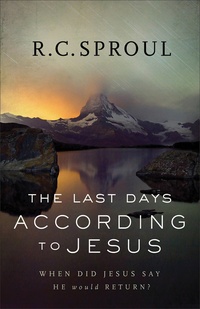
The Last Days According To Jesus by R.C. Sproul

The Last Days According to Jesus by R.C. Sproul

Review:

Sproul tackles the issues surrounding the interpretation of Jesus’ teaching recorded in Matthew 24, Mark 13, and Luke 21.  These passages reflect each of the Synoptic writer’s record concerning what we call the Olivet Discourse.

Sproul addresses this section because of his concern for the chaos that abounds due to the “crisis in eschatology.”  He outlines the conflicting views regarding the interpretation of Jesus’ teaching by summarizing the positions.  Radical Preterism sees all of the events prophesied by Jesus as already happening, meaning the kingdom is a present reality.  Sproul explains the view of Moderate Preterism, which identifies that many of the New Testament prophecies have been fulfilled, while maintaining that some crucial prophecies have not yet been fulfilled.  The third position is that of Dispensationalism, which regards the kingdom as future.

Sproul largely addresses the writings of James Stuart Russell and his opinions regarding the Olivet Discourse.  Russell’s position would qualify him as holding to Radical Preterism.   Through a careful examination of the Olivet Discourse, Sproul concludes that there are prophecies clearly made concerning the destruction of Jerusalem and the Temple, as well as  about the Parousia of Christ.  They also agree that there are signs that portend these events.

In Matthew 24:34 Jesus said, “This generation will by no means pass away till all these things are fulfilled.”  Sproul identifies this statement as leading to a key question: What “generation” will witness the end?  By carefully analyzing the contrasting views of Russell and Herman Ridderbos, Sproul presents the conclusion that either all of the content of the Olivet Discourse has occurred, or at least some of the events have failed to take place within the time-frame.

He questions how they could have fully taken place and what hope that leaves for Christians regarding a future return of Jesus.  Taking a careful approach Sproul considers the issues of interpretation.  The events could be interpreted in a strictly literal sense.   The events could be literally interpreted while the time frame is figurative.  Or the time frame is literally interpreted while the events are figuratively interpreted (this is the view of the Preterists.  Because of these issues, Sproul sees that there is a greater future hope outlined for the church and thus a need to distinguish Radical Preterism from Moderate Preterism.

Thus far the first two chapters are summaraized.  Sproul then spends some seven chapters addressing the nuances that distinguish the two camps.  By carefully applying the aforementioned perspectives and careful hermeneutic, Sproul works through key issues regarding eschatology.  He addresses Paul’s teaching, the destruction of Jerusalem, John’s teaching in Revelation, matters of the resurrection, the antichrist, and positions regarding the millenium.

Sproul certainly accomplishes what he desired when he set out to address interpretive issues pertaining to eschatology.  He does it in a concise and clear manner.  He clearly indicates the Reformed perspective on the matters while carefully addressing the various positions.  He concludes with a call to greater diligence and persistence in seeking the solution of these things that will continue to be exceedingly difficult to interpret.  The Christian reader ought to pursue this discipline to offer hope to a skeptical world that Scripture is divine authority and Christ is a credible Savior.

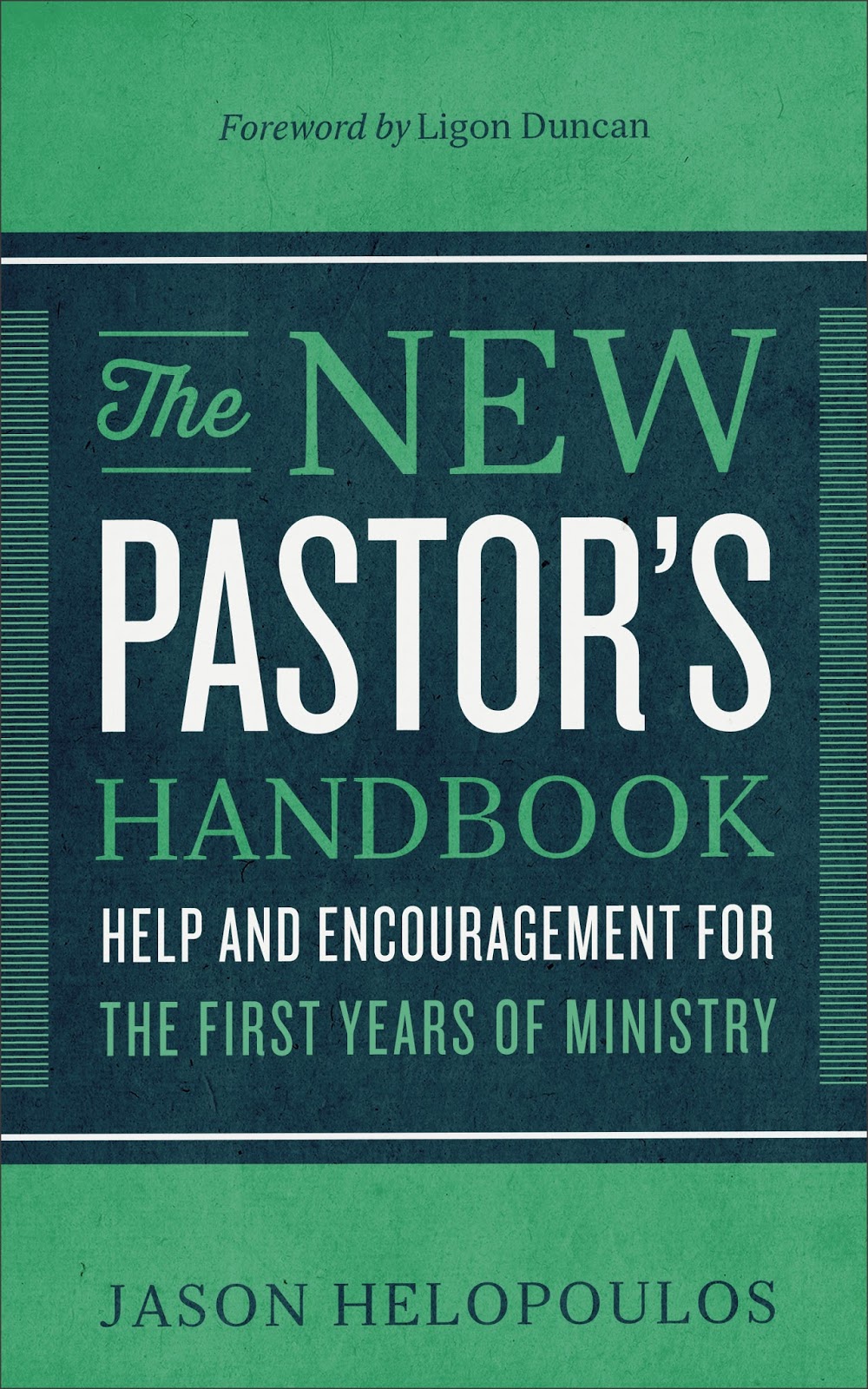
Book Review – The New Pastor's Handbook by Jason Helopoulos

Jason Helopoulos hits a home run in his book, The New Pastor’s Handbook.  I believe that this book should be on every reading list for Practical Christian Ministry in either College or Seminary.  It will be especially helpful for young men committing to the pastorate.  
Each chapter is full of sagely counsel that will easily direct and more importantly give practical perspective for any man (or woman) looking at serving in full-time Christian ministry.  Helopoulos begins by shaping thoughts regarding the importance of a call to ministry.  Having been in full time ministry for over 23 years now, I must concur that one’s sense of call internally and one’s confirmation of calling by a local body can together be stabilizing elements the Lord uses during difficult seasons.  Every minister of the gospel will need these elements and the ability to recall God’s plans for them.  Helopoulos succinctly aids the young pastor by clarifying these elements and their significance.
Young pastors will need further counsel through the years of ministry.  That counsel extends beyond an evaluation of their calling to serve in ministry.  They will need encouragement in a number of areas.  Helopoulos considers the importance of the focus of ministry in early years, the practice of reading a variety of books, as well as one’s priority to shepherd their first flock – their family.   As I continued to read the areas of encouragement that Helopoulos addresses, I thought how carefully it seemed he had observed my own life as a pastor.  I recognized that this work contains incredibly important information for a young minister that comprehensively addresses the areas they will encounter through many years of ministry.
Helopoulos provides practical wisdom to avoid pitfalls that will be encountered at points of one’s ministry.  He addresses several specific topics that I have found to creep into the thought process and impact me negatively regarding my own ministry.  This book will help guide one’s heart and and practice in positive biblical truth.  This extends from practical preaching, the use of illustrations, disappointments in people, etc.  These chapters provide invaluable insight regarding matters every minister will face at some time.  
Lastly he concludes with a section on the Joy of Ministry.  In these few short chapters he addresses the great privilege and blessings of serving in pastoral ministry.  Though certainly not exhaustive in their content, consistent with the entirety of the book, Helpoulos succinctly highlights the greatest privileges and joys.  These highlights will serve as reminders of the specifics moments particular to you and your own ministry.  

In conclusion, I am so thrilled that this book is available.  Over the years I have ministered to several people who were called to ministry.  Unfortunately I never knew of a sufficient resource that would be empowering, practical, and comprehensive.  The New Pastor’s Handbook certainly fulfills those areas in excellence.

Self – Less Living

I am preparing for the next sermon series on Romans at church.  In my preparation reading I found some interesting comments by John MacArthur that I thought worthy for reflection.  He writes,

The ultimate goal in many lives today is little more than perpetual self- satisfaction. Every object, every idea, every circumstance, and every person is viewed in light of what it can contribute to one’s own purposes and welfare. Lust for wealth, possessions, fame, dominance, popularity, and physical fulfillment drives people to pervert everything they possess and everyone they know. Employment has become nothing more than a necessary evil to finance one’s indulgences. As is often noted, there is constant danger of loving things and using people rather than loving people and using things. When that temptation is succumbed to, stable and faithful personal relationships become impossible. A person engulfed in self- will and self- fulfillment becomes less and less capable of loving, because as his desire to possess grows, his desire to give withers. And when he forfeits selflessness for selfishness, he forfeits the source of true joy.

Selfish greed progressively alienates a person from everyone else, including those who are closest and dearest. The end result is loneliness and despair. Everything that is craved soon yields to the law of diminishing returns, and the more one has of it the less it satisfies.

Reading this made me think about the number of people in churches today who seek only what can lead to their own satisfaction.  This is nothing more than a modern day idolatry.  How the Lord desires for us to serve Him and others at the core of our hearts and with the fruits of our lives. 

A few weeks ago I challenged that church should not be about “what I can get,” nor should it be about “what I can give,” instead it should be about “what others can gain.”  The others to whom I am referring are two audiences.  The first audience is the Lord, for He gains our worship and adoration.  The second audience is the world around us, whether that be our church community or the community in which we live and work.  This fulfills the two greatest commandments.  Love the Lord your God and Love your Neighbor as Yourself. 

Selfishness will only prohibit the best worship and service from happening.  There is a return when we get this right and it is directed at ourselves, it is joy.  This joy is truly bound in our relationship with Jesus as we steward the grace we have discovered in Him.  MacArthur concludes that there is a law of diminishing returns when we crave the wrong thing. So the question for every one of us is: By what are you satisfied?

Accountability

I am still working through Hioliness by Grace, by Bryan Chapell.  He was talking about mercy in the chapter I am in, and interjected a unique experience that reminded me of the values of relationships in the church, especially personal relationships that may know the intimate details of our lives.

He writes (referring to a conversation he had with another pastor), “He said he had discovered that his own walk with the Lord could be charted according to his level of accountability to other Christians. He said, “I have discovered in the Christian life that you are moving either toward or away from accountability.” Very few healthy things in the Christian life happen in secret. If you cannot or will not tell your spouse, your peers, or your superiors about something, then accountability falters. Our immersion in and integrity with these patterns of Christian association and accountability are ordinary means by which we grow in godliness.”

When I read this, I am certainly reminded of the ebbs and flows in my own life in relationship with Christ.  The moments that I seem to have the greatest level of intimacy with him are certainly identified when I am at my most transparent moments, vulnerable, and honest with others in my life.

For over a year now I have been working hard to maintain an accountability relationship with a mentor of mine from my early days of becoming a follower of Jesus by grace through faith.  This friendship provides encouragement, stability, strength, and helps to prevent me from wandering away from the Lord into sin.  Between my friend, my wife, and my attempts to be transparent with my fellow elders (other peers) I a convinced the flow is in the greater, growing level of intimacy with Jesus.  These are the people who have spurred me on to a better relationship with Jesus.  I am more inclined to wrestle against my flesh, more resolved to battle every day, and intentional in my efforts for sacrificial living.

I trust that you wil consider your own life, specifically whether you are moving toward or away from accountability.  I hope that you will make any necessary steps to instill accountability in your life to afford the means to grow in godliness.

Eyes For You

I was reading a devotion by C.H. Spurgeon and was reminded of the phrase, “I only have eyes for you.”. You might have heard some young man say that to the girl he is courting or to his wife.  I have been around a few people in my life who live in such a way with their wives.  My Grandfather exhibited that kind of love with my Grandmother, it was incredible to watch.   What is more telling though than any earthly relationship though is what the Lord does for us His bride.  Spurgen was commenting n a verse in the Song of Solomon, which is a book that many believe is an allegory of the Lord and the church, His Bride.  Song of Solomon 4:7 reads, “You are altogether beautiful, my love; there is no flaw in you.”

The reason it can be said that the bride is altogether beautiful, and there is no flaw is because the Lord is at work in His Bride.  Spurgeon gives reason why . . . 

He views her in Himself, washed in His sin-atoning blood and clothed in His meritorious righteousness, and He considers her to be clothed in comeliness and beauty.  No wonder that such is the case, since it is but His own perfect excellency that He admires; for the holiness, glory, and perfection of His Church are His own glorious garments on the back of His own well-beloved spouse.  She is not simply well proportioned; she is altogether beautiful!she has actual merit! Her deformities of sin are removed; but more, she has through her Lord obtained a meritorious righteousness by which an actual beauty is conferred upon her.

You see, the Lord only has eyes for us, His bride.  No matter the flaw of sin, or the deformity we may have, it is covered by his righteousness imputed (conferred upon) to us.  With this in mind, I sense that I should respond more as he sees me, I should look down at the garments of grace and see myself as he sees me.  It should cause celebration, it should transform living, habits, and thoughts, so that the garments are not dirtied by further disobedience and sin.  

As a husband, this picture also makes me think about my call to love Katie as Christ loves the church.  My calling is to have eyes only for her so that she fee altogether lovely; that her glory and satisfaction would be secured by godliness in me as I imitate Jesus and His love for His bride.  When she finds her beauty to be superlative because I have made much of it (not just outward, but her character as much), I trust that she will find greater strength and be assured of her beauty and our love for one another will be evident to all.  So I encourage you, to find yourself with the eyes of the Lord upon you and know His perception of you, and then, live a life that is pleasing to Him for the work He has secured, for you are altogether beautiful and you do have merit and you are priceless to Him.

Only For You

I was reading a devotion by C.H. Spurgeon and was reminded of the phrase, “I only have eyes for you.”. You might have heard some young man say that to the girl he is courting or to his wife. I have been around a few people in my life who live in such a way with their wives. My Grandfather exhibited that kind of love with my Grandmother, it was incredible to watch.

What is more telling though than any earthly relationship though is what the Lord does for us His bride. Spurgen was commenting n a verse in the Song of Solomon, which is a book that many believe is an allegory of the Lord and the church, His Bride. Song of Solomon 4:7 reads, “You are altogether beautiful, my love; there is no flaw in you.”

The reason it can be said that the bride is altogether beautiful, and there is no flaw is because the Lord is at work in His Bride. Spurgeon gives reason why . . .

He views her in Himself, washed in His sin-atoning blood and clothed in His meritorious righteousness, and He considers her to be clothed in comeliness and beauty. No wonder that such is the case, since it is but His own perfect excellency that He admires; for the holiness, glory, and perfection of His Church are His own glorious garments on the back of His own well-beloved spouse. She is not simply well proportioned; she is altogether beautiful!she has actual merit! Her deformities of sin are removed; but more, she has through her Lord obtained a meritorious righteousness by which an actual beauty is conferred upon her.

You see, the Lord only has eyes for us, His bride. No matter the flaw of sin, or the deformity we may have, it is covered by his righteousness imputed (conferred upon) to us. With this in mind, I sense that I should respond more as he sees me, I should look down at the garments of grace and see myself as he sees me. It should cause celebration, it should transform living, habits, and thoughts, so that the garments are not dirtied by further disobedience and sin.

As a husband, this picture also makes me think about my call to love Katie as Christ loves the church. My calling is to have eyes only for her so that she fee altogether lovely; that her glory and satisfaction would be secured by godliness in me as I imitate Jesus and His love for His bride. When she finds her beauty to be superlative because I have made much of it (not just outward, but her character as much), I trust that she will find greater strength and be assured of her beauty and our love for one another will be evident to all. So I encourage you, to find yourself with the eyes of the Lord upon you and know His perception of you, and then, live a life that is pleasing to Him for the work He has secured, for you are altogether beautiful and you do have merit and you are priceless to Him.

Across the Bow

I love movies like Master and Commander, Pirates of the Caribbean, and Mutiny on the Bounty.  The impressiveness of the ships holds my attention easily, but even with awe when the battle scenes occur.  One of the things that I have learned watching these movies is the proximity that is required when the battles ensue and I am often reminded of that phrase, “fire a warning shot across the bow.”

In my studies of Genesis I believe that we “find a warning shot being fired across the bow” for parents.  In chapter 34 we have the account of Jacob’s sons and daughter.  In verse 1 we read, “Now Dinah, the daughter Leah had borne to Jacob, went out to visit the women of the land.”  Unfortunately, the next verse expresses a tragic outcome to the visit.  Scripture says, “When Shechem son of Hamor the Hivite, the ruler of the area, saw her, he took her and violated her.”

This situation sheds light on a variety of principle issues that families face everyday.  The first principle is that God’s people should make their dwelling where the Lord is, obediently pursuing his plans.  Jacob failed to do this for his family.  Earlier the Lord had instructed Jacob to go to Bethel (the House of God), but Jacob stopped short, settling in the neighborhoods of Succoth and Shechem.  Jacob should have settled where the Lord called him, especially in a location that would have offered the security of God’s presence.  Jacob wasn’t going to serve effectively in a place God had not called him to.

Settling in the wrong place impacts the family in another way, because there is another principle violated. Evidently Dinah was lonely, needing female companionship.  Who could blame her, she was very likely the only daughter among 11 boys.  She was probably in her early to late teens and thought she was going to be able to handle the world.  However unfortunately, she was allowed to go into the world unchaperoned.

Before we are too quick to jump to any conclusions about Dinah’s character let’s note a couple of things about Jacob at this point.  As you continue to read this chapter you will notice that Jacob is very indecisive, he is invisible when decisions are enacted, he is concerned about his reputation rather than his daughter’s and he abdicates the responsibility of justice.  James Montgomery Boice writes the following in regards to this, “I do not know the source of Jacob’s failures (spiritual poverty, weaknesses of character, or something else).  But I do know where the failures of many of today’s fathers come from.  They come from being “too busy” or from being afraid that their children will hate them if they establish discipline and set household laws.  If you are a father and have been failing in this area, reverse that failure, whatever your children may think.”

The third principle that failed to register for Jacob is to remember that the world is wicked.  You might want to argue with me at this point, but I would simply remind you of this truth.  We fail to recognize that the evil of “good” people might be even worse – worse because we fail to recognize it as evil and we deny that it is evil.  We become much like the frog in the kettle, when placed in when the water is cool it will stay all the while when the water is turned to boiling and it will die.  Let us not allow our children to be brought up with this kind of environment, instead let us alert them to the dangers of the world.

Finally, the religious practices of Jacob’s sons was not one of devotion to relationship with the Lord, but one of mere practical purposes.  You see they abused their neighbors in Shechem by misusing the religious practices of their day.  Sometimes we need to be cautious with those who claim to be of God because they can abuse those around them by false understanding and practices.  This means that we need to be people who study the Word with care and discuss it with our children so that they possess the truth themselves and will not be abusive as they live out their faith.

I hope that this is a warning shot to all of us who are parenting so that we are committed to, courageous for, careful in, contrasting the world and communicative about our faith with the Lord Jesus so that our children will be thoroughly equipped for every good work.

More Than Gold

I received an encouraging comment this week from a friend in our church. They referenced the passion I had while communicating a specific point of the message this week. In particular it was the remarks Job made regarding meeting his redeemer (Job 19:25). In thanking them for the encouragement I realized something that I hadn’t consciously considered before. My response to their email was this, “I hope that what Job must have felt at that statement was captured a bit. It is one of the most remarkable declarations in Scripture!”

Now I know there is not much in that statement that is very profound, but as I typed it out I began to realize that oftentimes I approach the reading of Scripture without attempting to understand the lives, emotions, and soul impact of the moments that the writers and/or characters must have been experiencing. For Job, the depth of his conviction and his zeal for the LORD in the midst of failing health, friends who condemned, and a contentious wife, must have driven him to be extremely clear. They demanded this clarification, a bold statement, no more than a mere statement, it is a definitive declaration for his commitment to God. It is bold in many ways, theologically (which is where I always focused first), emotionally, relationally, rationally, and philosophically. I really get the sense that it consumed all of Job’s being in that moment.

There is a song by a band named the Swift titled, More Than Gold, that captures what I am trying to express, maybe it will help you too. Here are the lyrics.

I heard Your word.
I crossed over to the holy side and saw what You can do.
But now I’m feeling like I could just die.
Seems it takes so long to get it right.

(Chorus)
More than gold, I love Your word. It speaks to me.
More than gold, I love Your word.
More than gold. I want to sing.
You know I do, but I can’t sit still and just be in awe of You.

It seems like my fire always dies.
Why does it take so long to get it right?

(Chorus)

Let me draw near to You, then You draw near to me.
I need Your word more than gold.
Because I consider Your word, I hate everything that is without You.
(Chorus)

Surely Job, must have this same thought in mind, that if he had all of his possessions and all of his children but was without the person of God, his kinsman Redeemer, he would have been empty. Thus this unprecedented expression burst forth declaring his alignment, his allegiance, his answer, and his assurance. I hope that this is an encouraging example of how we can read the Word of God and be transformed as it speaks to us in a powerful way because it is alive and active and sharper than a double-edged sword. May the Lord bless you in the reading of His Word!

Reading With Your Children – More Than Reading

At Christmas time last year Katie and I gave two books to our oldest children (Rebecca and Christian). They are the first two of four in the Wingfeather Saga, a series written by Andrew Peterson. I actually had the privilege of meeting Andrew several years ago when I was doing youth minister in East Tennessee. He is an incredible musician and I was excited to learn about these books from Jonathan Taylor Martin of Mosaic.

Unfortunately our kids didn’t decide to jump into the books and even after some encouragement to read them. One of them actually began reading the first book and started complaining about the character development with great frustration. I waited to see if the book would be given a chance only to find it back on the shelf where it had sat for a few months. At that point I got my dander up a little bit and decided I was going to read the series and see if I could build a little encouragement and momentum.

Jonathan was absolutely correct in his recommendation and I was thrilled to be reading the series. I quickly finished the first two only to wait on the release of the third (yes now I am waiting on the fourth too, with eager anticipation). As great as the books are, what I noticed was very interesting as I began to drop comments about my enjoyment of Andrew’s writing and the story line. Christian began to ask me questions and was amazed that I had finished them so quickly.

He had been dragging his feet to complete the reading I had assigned for the summer (Treasure Island), so I didn’t anticipate the response when he picked up the first book and started into it. After about 2 days, maybe 8 chapters in he was coming to me and reporting on his progress in the story and started asking questions about the future of specific characters and trying to make guesses in the outcome of particular circumstances. Never did I give away anything in the story line, but I would drop some hint to cause him to think or just return his question with a raised eyebrow (at least raised to the best of my ability) which would drive him mad with intrigue at the future events for the characters.

He has almost finished the third book in the 4 weeks (Treasure Island took him about 8), and we had an incredible discussion about the characters, their flaws, their likenesses to real people. We discussed the hints of redemption that Andrew brings out through the story and enjoyed a great conversation about the benefits of this in our own lives. It brought a great spiritual lesson home to me.

Paul says in 1 Corinthians 11:1, “Be imitators of me, as I am of Christ.” My son, Christian, caught the excitement of reading the books after I modeled excitement before him. He started understanding the symbolism and deeper matters of the books when we talked together. This made me realize that the manner in which our children will grasp the Gospel (Good News of Jesus Christ and all that it entails) is for us, as parents, to engage in a walk with Jesus which models the significance of the Gospel. As we are transformed by our friendship with Jesus, by our prayer life with the Father, and by the empowering of the Holy Spirit, our children will see this and most likely model Christ because of the value He holds for us. One day they will possess their own faith, but for now, I sure want to set Christ before them as I imitate Him. That doesn’t happen merely by reading a book, but it happens by embracing them in relationship as Christ has embraced us.